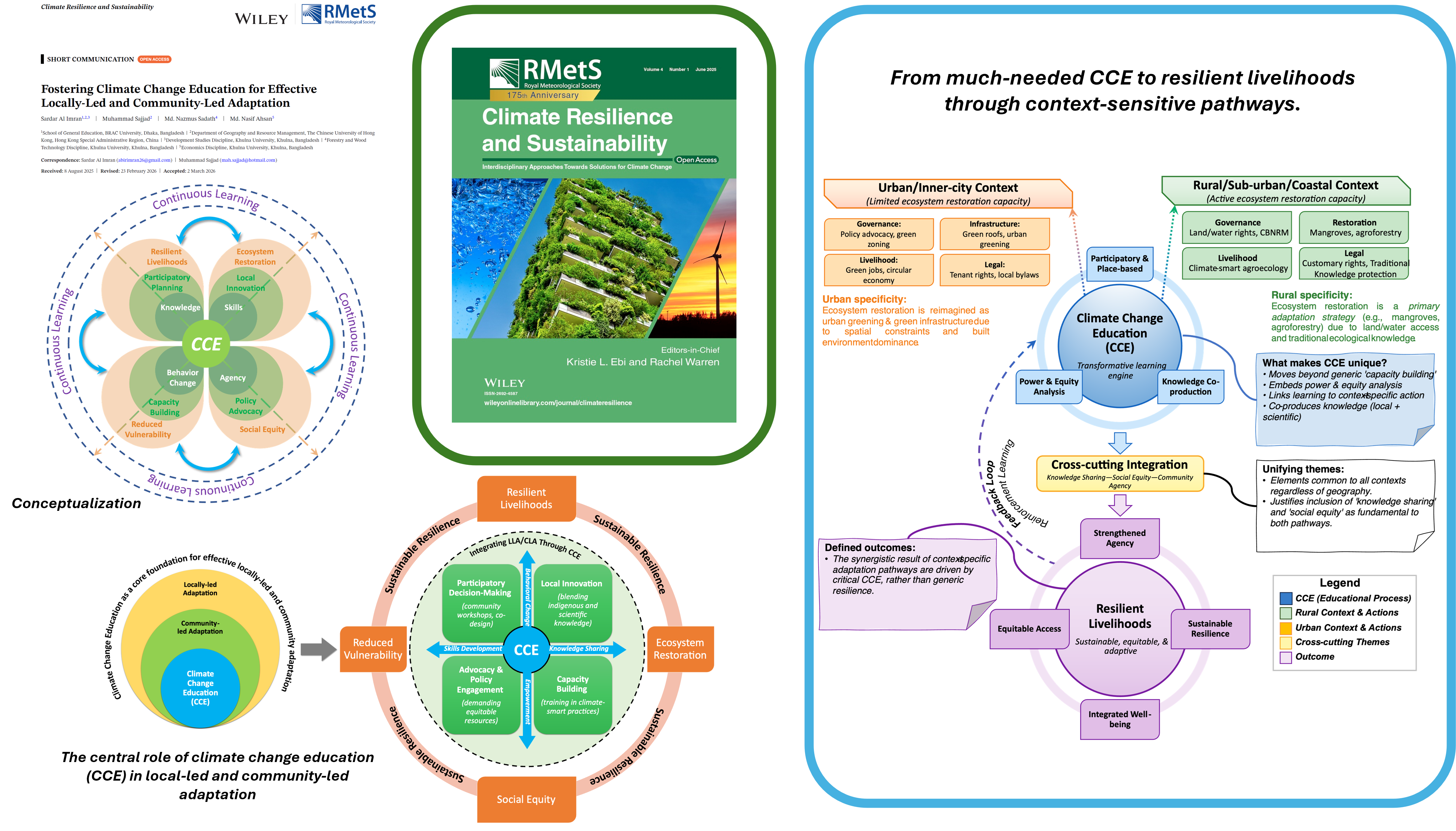
My colleagues and I just published a new #opinion paper that tackles a question I've wrestled with for years: If locally-led adaptation (LLA) and community-led adaptation (CLA) are so widely advocated, why do so many initiatives still fall short? We've seen it time and again. A project empowers individual households but can't fix shared drainage or protect vulnerable groups from being left behind. Another mobilizes the whole community but collapses when donor funding ends or gets dominated by local elites. The frameworks are sound, but the outcomes are inconsistent. In our just-published study in Climate Resilience and Sustainability, we argue the missing piece is hiding in plain sight.
The Problem: The Hidden Gaps in "Local" Adaptation
LLA and CLA are essential bottom-up approaches. But our review of the evidence shows they face predictable barriers when implemented alone:
- Fragmentation: LLA lets households act, but without coordination, efforts are duplicated and systemic risks (like coastal erosion) go unaddressed.
- Inequity: Without shared knowledge and civic capacity, participatory processes can be captured by well-connected groups, leaving marginalized voices out.
- Unsustainability: CLA often relies on external facilitators. When they leave, the project's knowledge and momentum often leave with them.
We realized these aren't failures of the communities. They are failures of infrastructure – specifically, the lack of an educational infrastructure that builds lasting, collective capacity.
Our Solution: Centering Climate Change Education (CCE)
We propose a fundamental shift: treating Climate Change Education not as a supplementary add-on, but as the central pillar of adaptation planning. This isn't about brochures or workshops. The CCE we envision is a transformative process that:
- Integrates scientific knowledge with local wisdom, ensuring solutions are both evidence-based and culturally relevant.
- Builds civic capacity – the skills communities need to navigate power structures, advocate for resources, and manage their own adaptation funds.
- Is co-created with communities, especially marginalized groups, ensuring they are not just informed but are active agents in designing their own future.
Key Findings: What CCE Actually Does
Our conceptual framework, grounded in evidence from the Global South, shows that embedding CCE fundamentally changes adaptation outcomes:
- For LLA: It moves households from reactive coping (e.g., sandbagging a door) to anticipatory planning (e.g., diversifying livelihoods based on understood risk profiles). We saw this in Pacific Island communities where education integrated traditional water management with climate forecasts, boosting household resilience.
- For CLA: It fosters the shared understanding and trust needed for genuine collective action. In Zimbabwe, grassroots climate education empowered communities to map local risks together and co-design water management strategies, creating ownership that outlasted any single project.
- For Equity: It explicitly addresses power. By ensuring all groups are literate in the issues and the decision-making process, CCE helps break down the barriers that prevent equitable implementation.
Policy & Practice Implications: A Call to Action
For governments, NGOs, and funders, this isn't just academic. Our work points to three concrete shifts:
- Redefine "Capacity Building": Move beyond short-term technical training. Invest in long-term, participatory education programs that build critical thinking and collective agency.
- Co-Design Curricula: Don't write educational materials in a capital city and drop them into a village. Mandate that local educators, leaders, and vulnerable groups co-create the content so it's relevant, respected, and owned by the community.
- Finance the "Invisible" Infrastructure: Just as we fund seawalls and irrigation, we must fund the educational infrastructure that makes those investments sustainable. Ask: Does our grant include a genuine, multi-year plan for community education and empowerment?
Take Home Message
Locally-led and community-led adaptation (LLA/CLA) often fails not because communities are incapable, but because we overlook a critical foundation: Climate Change Education (CCE) as a transformative, long-term process. Our research argues that without an educational infrastructure, LLA becomes fragmented and CLA becomes unsustainable. True CCE is not a one-off workshop; it is a co-created process that builds civic capacity, integrates local and scientific knowledge, and explicitly addresses power imbalances. The evidence shows that when education is embedded into adaptation, households move from reactive coping to anticipatory planning, and communities develop the shared trust and collective agency to design projects that outlast any external funding cycle. We call on governments and funders to treat CCE as essential, foundational "infrastructure"—not an optional add-on. The policy implications are clear: invest in long-term educational programs, mandate co-designed curricula with communities, and fund the people and processes that make adaptation sustainable. The bottom line: You cannot have effective, equitable, and lasting local adaptation without an educated community driving it. It's time to make CCE central to our adaptation strategy.
I'd love to hear from practitioners and policymakers: Have you seen the "education gap" undermine adaptation projects? What's worked in your experience?
The Original Work
This post is based on our research paper: "Fostering Climate Change Education for Effective Locally-Led and Community-Led Adaptation" published in Climate Resilience and Sustainability, 2026.